Redesigning the device physics of an ARM microprocessor to meet a 200 MHz spec within an energy budget.
Objective. In 6.012, students learn the fundamentals of semiconductor physics and how to analyze and predict device performance from scaling laws and physical structure. The final challenge: take an existing ARM microprocessor structure and propose an energy-efficient design that meets spec and operates at 200 MHz.
Solution. Over the last two weeks of the semester, my group made four changes to the existing semiconductor design to optimize performance. We decreased the oxide thickness to 4 nm to reduce parasitic capacitance on the MOSFET; changed the spacer material to one with lower permittivity to cut leakage capacitance; increased source/drain doping to the upper limit to raise channel carrier count (and thus current); and lowered the operating voltage to 1.75 V to meet spec.
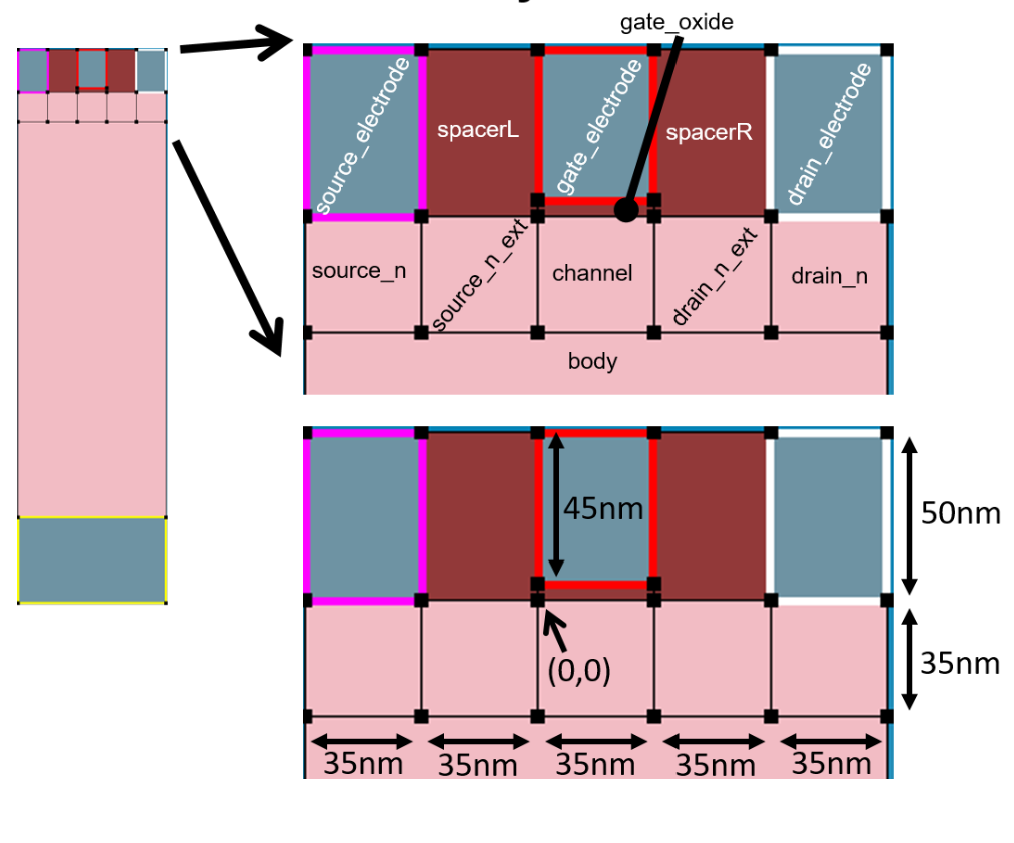
Microprocessor performance was modeled in Sentaurus, and gate-capacitance calculations were done in MATLAB. See the paper for the full analysis.